
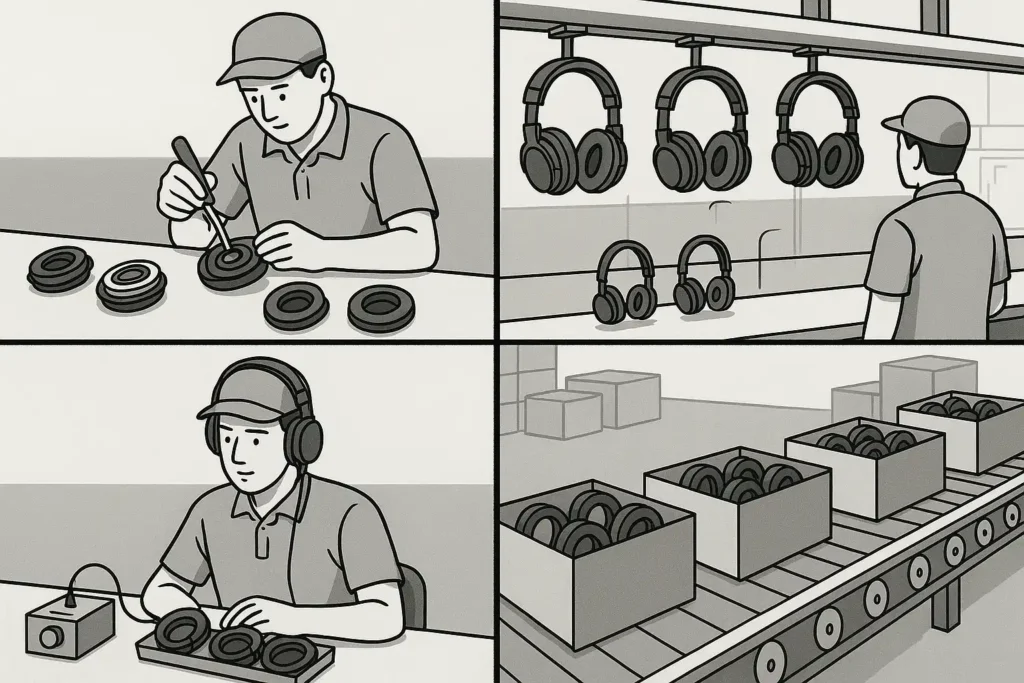
Headphone Production Lead Time Explained
In the headphone industry, timing is everything.
A delayed launch doesn’t just affect schedules—it can also mean missing peak sales windows, losing competitive advantage, and weakening brand momentum. Therefore, whether you are developing a new product or scaling an existing one, headphone production lead time directly impacts how fast your brand can respond to the market.
From industry observations, delays rarely come from a single issue. Instead, they usually result from gaps across development, supply chain, and manufacturing coordination.
Product Development Challenges That Extend Timelines
For new headphone projects, development often creates the first bottleneck.
At the beginning, teams move from industrial design to structural engineering and acoustic tuning. This stage already takes months. However, once teams finalize the initial design, new challenges quickly appear.
For example, during integration:
- Sound performance may not meet expectations
- Internal components may interfere with each other
- Call quality may become unstable
- Waterproofing or certification may fail
As a result, engineers must adjust, test, and validate repeatedly. Because of this, development iterations often extend the headphone production lead time more than expected.
In addition, after finalizing the product, teams still need to complete certification, testing, and material preparation before mass production can begin.
Supply Chain and Manufacturing Efficiency Gaps
Once products enter trial production, delays usually shift from development to execution.
In many cases, production teams face challenges such as:
- Slow material preparation from suppliers
- Weak coordination across the supply chain
- Inefficient production workflows
- Quality issues that require rework
Consequently, these problems reduce output efficiency and increase uncertainty. Over time, they directly extend the overall headphone production lead time.
More importantly, production speed does not depend only on factory capacity. Instead, it relies on how well the entire system works together.
Building a System That Reduces Lead Time
To reduce delays, companies must improve coordination across all stages.
At HONSENN, we focus on building an integrated system that connects development, supply chain, and production processes.
Specifically, we:
- Align structure, acoustics, and electronics early through parallel development
- Use strong ODM & OEM capabilities to accelerate product realization
- Standardize production through SOP-based systems
- Maintain stability with ISO-certified management
Because of this structured approach, our teams reduce uncertainty and improve overall efficiency for global customers.
Why Stability Drives Faster Delivery
Many brands focus on speed. However, they often overlook consistency.
In reality, a stable system allows teams to:
- Keep development on track without repeated delays
- Maintain smooth production at scale
- Deliver products on predictable timelines
Therefore, improving headphone production lead time is not about rushing production. Instead, it is about building a reliable process that performs consistently from start to finish.
Conclusion
In the headphone industry, delays rarely come from isolated problems. Instead, they usually result from disconnected processes.
By improving coordination across development, supply chain, and manufacturing, brands can significantly reduce headphone production lead time and stay competitive in fast-moving markets.